How to hire a freelance WordPress developer without regrets
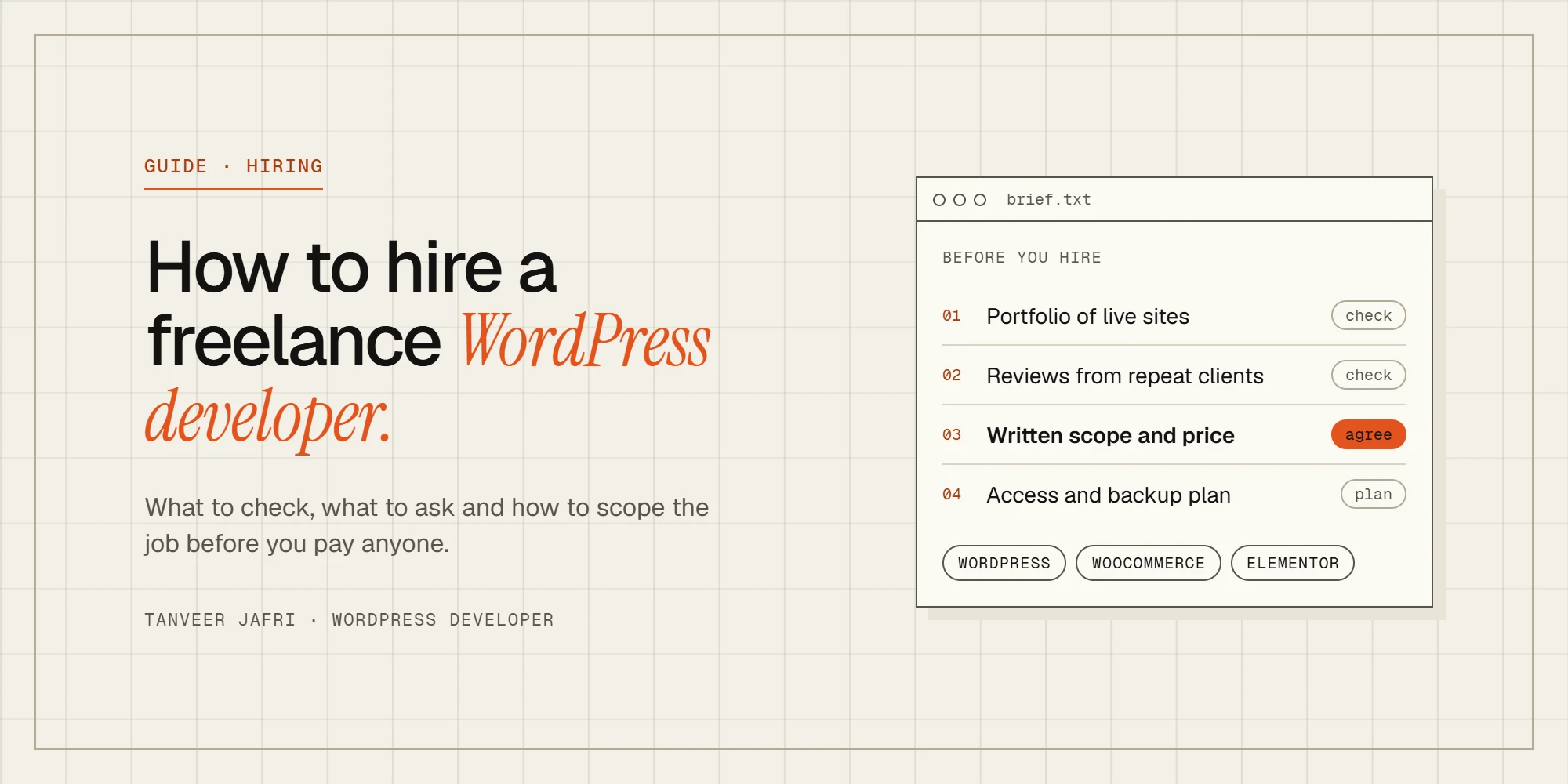
What to check in a portfolio, which questions to ask and how to scope a WordPress project so you get what you paid for.
If you want to hire a freelance WordPress developer, you have more choice than ever: marketplaces, agencies, referrals and thousands of portfolios. That choice is also the problem. Two developers can quote the same job at very different prices, both sound confident, and you only find out which one was right after launch. This guide is the checklist I’d give a friend before they hire anyone, including me.
Decide what kind of help you need
“WordPress developer” covers several different jobs, and most hiring mistakes start with mixing them up. Before you write a brief, decide which of these you actually need:
- Site builder or designer. Builds pages with Elementor, Gutenberg or a theme, sets up menus, forms and basic SEO. Right for brochure sites, landing pages and redesigns.
- WooCommerce developer. Handles products, payments, shipping, taxes and the custom rules that real shops always end up needing.
- Plugin or PHP developer. Writes custom code: integrations with other systems, custom post types, admin screens, REST endpoints and features no off-the-shelf plugin covers.
- Maintenance and troubleshooting. Fixes errors, speeds up slow sites, cleans up after hacks and keeps updates safe.
Many freelancers do more than one of these well, but nobody is equally strong at all of them. If your project is mostly custom WooCommerce logic, a portfolio full of pretty landing pages tells you very little.
Write a short brief before you contact anyone
A one-page brief saves you time and gives you quotes you can actually compare. It doesn’t need to be technical. Include:
- What the site or feature is for, and who uses it.
- What exists today: your current URL, hosting, theme and the plugins you rely on.
- What must change, and what must not break.
- Two or three sites you like, and what exactly you like about them.
- Your deadline and whether it’s fixed or flexible.
- A budget range. Developers aren’t trying to take all of it; a range simply tells them which solution to propose.
If you’re not sure what’s technically involved, say so. A good developer will ask questions rather than guess.
How to judge a portfolio
Screenshots are easy to fake and easy to polish. Live sites are harder. When you look at a portfolio:
- Open the live sites on your phone. Most of your visitors will. Check that menus work, text is readable and pages don’t jump around while loading.
- Look for work like yours. A WooCommerce store with custom checkout rules is evidence of WooCommerce skill. A personal blog isn’t.
- Read the case studies, not just the thumbnails. A developer who can explain the problem, the approach and the result usually understands what they built. You can see how I document projects on my work page, from a B2B customer approval plugin to full site builds.
- Ask what they did on each project. “I built this” can mean the whole site or one contact form.
Reviews: look for repeat clients
Five-star ratings are common on every platform, so the average alone doesn’t separate people. What does is repeat business. A client who comes back for the fifth or tenth project has seen the developer’s work after launch, when bugs appear and updates arrive. That’s the part a first-time review can’t tell you.
When I collected my own reviews for my reviews page, the pattern that mattered most was how many came from returning buyers: repeat orders make up most of the 294 reviews on my Fiverr profile. Whoever you hire, ask how many clients have stayed with them for more than one project.
Questions to ask before you hire
These questions reveal more than any test task:
- How would you approach this, and what could go wrong? Good developers mention risks: plugin conflicts, data migration, SEO during a redesign, payment testing.
- Will you work on a staging copy first? Changes to a live site, especially a shop, should be built and tested on a copy.
- What will you need from me, and when? Content, logins, brand files and decisions are common causes of delay.
- Who owns the code and the design when we’re done? You should. Get it in writing.
- What happens after launch? Ask how bugs found in the first few weeks are handled and what ongoing help costs.
- How do you take backups before making changes? “I don’t” is the wrong answer.
Scope and price: get it in writing
Most disputes between clients and developers come from a scope that was never written down. Before work starts, agree on:
- A list of deliverables: pages, features, integrations.
- What’s out of scope, especially copywriting, images and ongoing maintenance.
- The number of revision rounds.
- Milestones and what you pay at each one.
- The launch date and who’s responsible for each step.
Fixed prices work well for clearly defined jobs. Hourly work suits ongoing support and problems where nobody can know the cause in advance, such as a bug that only appears for some customers. If a developer gives you a fixed price for an undefined problem, they’ve either padded it or they’ll ask for more later.
For reference, my contact form asks for budget and timeline up front, and projects start from $200. That isn’t a sales trick: it lets me suggest the right solution in the first reply instead of three emails later.
Protect your site and your access
Hiring someone means giving them access to your business. Do it safely:
- Create a separate admin account for the developer instead of sharing your own password, and delete it when the job ends.
- Use your own hosting account. If a developer hosts your site on their account, moving away later can be painful.
- Take a full backup before work starts, and keep a copy yourself.
- Share passwords through a password manager or a one-time link, not plain email.
- Keep your domain in your name. Never let anyone else register it for you.
Red flags
Walk away, or at least slow down, if you see:
- A quote before they’ve asked a single question about your site.
- Pressure to pay everything up front for a large project.
- No staging site, no backups, no testing plan.
- Nulled (pirated) premium themes or plugins. They often contain malware and never get updates.
- A promise of “first page of Google in two weeks”.
- Vague answers about who will actually do the work.
Marketplace or direct?
Marketplaces such as Fiverr and Upwork give you payment protection, public reviews and a dispute process, which is valuable when you’re hiring someone for the first time. Hiring directly gives you a simpler relationship and often more flexibility once trust exists. Many of my long-term clients started on Fiverr and later moved to direct work once we knew each other. Both are fine; what matters is a clear scope and good communication.
Frequently asked questions
How much does it cost to hire a freelance WordPress developer?
It depends on what you need. A small fix might take an hour; a custom WooCommerce store can take weeks. The biggest factors are the number of unique page designs, custom functionality, integrations and how much content needs moving. As a reference point, my hourly rate is US$15 and fixed-price projects start from $200.
Should I hire a freelancer or an agency?
An agency gives you a team and more capacity, at a higher price and with more layers between you and the person doing the work. A freelancer is usually more affordable and you speak to the developer directly. For most small and mid-sized business sites, an experienced freelancer is enough.
Can a developer in another country work on my site?
Yes. WordPress work is done remotely almost everywhere. What matters is clear communication, reliable availability and some overlap in working hours. I’m based in Pakistan and work with clients in the US, UK, Europe and Australia, and I reply to new enquiries within 12 hours.
Ready to hire?
If you’ve written your brief and want a second opinion, send it to me. I’ll tell you honestly what’s involved, what I’d recommend and whether I’m the right person for it. You can also see the services I offer and read what clients say about working with me.

Tanveer JafriFreelance WordPress developer. I build WooCommerce functionality, custom plugins and Elementor Pro sites. About me